
Term vs. Permanent Life Insurance: Which One Is Best For You in [2026]
Term life insurance provides coverage for a specific period of time, while permanent life insurance covers you for life.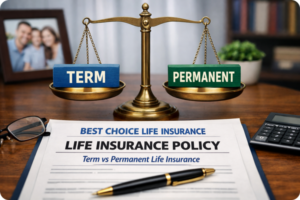
The subject of term vs. permanent life insurance is a question people have to carefully consider.
Choosing life insurance can feel overwhelming, but it’s one of the most important financial decisions you’ll ever make for your loved ones.
The core of this decision often boils down to a simple question: Term vs. Permanent life insurance?
You’ve likely heard these terms thrown around, but what do they actually mean? More importantly, how do you know which one is the best life insurance for your family?
At Best Choice Life Insurance, we believe an informed decision is the best decision. Let’s break down the key differences, pros, cons, and limitations to help you find the right fit.
Table of Contents
What Is Term Life Insurance?
Think of term life insurance like renting a home. You get coverage for a specific period of time—a “term.” This is typically 10, 20, or 30 years.
How it works:
You pay a fixed premium for the duration of the term. If you pass away during that period, your beneficiaries receive a death benefit—a tax-free lump sum. If you outlive the term, the policy simply expires, and there is no payout.
Who it’s for:
Term life is an excellent choice for individuals and families who need coverage for a specific financial obligation that will one day go away. This could be a mortgage, car loans, or the years your children are financially dependent. It’s a way to ensure your family’s financial security during their most vulnerable years.
Example:
Sarah and Mark buy a 20-year term policy to cover their mortgage. The policy lasts exactly as long as their mortgage payments. If one of them passes away during this period, the death benefit can be used to pay off the home, ensuring the surviving spouse and children don’t lose their house.
What is Permanent Life Insurance?
Now, let’s look at the other side of the coin. What is permanent life insurance? Unlike term, this type of policy is designed to provide lifelong coverage—as long as you continue to pay the premiums.
How it works:
Permanent policies combine a death benefit with a cash value component. A portion of your premium goes toward the death benefit, and the rest goes into a separate, tax-deferred savings account that grows over time. You can borrow against this cash value or make withdrawals while you’re still alive.
There are a few different types of permanent life insurance, but the two most common are Whole Life and Universal Life.
Whole Life Insurance:
This is the most straightforward type of permanent policy. Your premiums and death benefit are fixed and guaranteed for your entire life. The cash value component grows at a predictable rate. This policy is simple and secure.
Universal Life Insurance:
Universal life insurance offers more flexibility than whole life. It allows you to adjust your premium payments and death benefit within certain limits. The cash value growth can be variable, depending on the policy’s structure.
Example:
John, a business owner, wants to leave a financial legacy for his children and grandchildren. He opts for a permanent life insurance policy.
Years later, he’s able to borrow against the policy’s cash value to help his son with a down payment on a house, and he knows that when he passes away, the death benefit will be there for his heirs, regardless of when that happens.
Term vs. Permanent Life Insurance: Pros and Cons
To help you with your decision, here’s a quick overview of the pros and cons of term vs. permanent life insurance.
Later in this post we will cover the many advantages of combining term and permanent life insurance for the perfect life insurance portfolio.
Term Life Insurance (Pros)
Affordability:
This is its biggest advantage. Term policies are significantly cheaper, making it easier to get a large amount of coverage for a low monthly premium. This is why it’s often considered the best life insurance for families just starting out.
Simplicity:
It’s easy to understand. You pay for a set amount of time, and you get a death benefit if something happens.
Flexibility:
You can choose a term that aligns with your specific needs, like the length of your mortgage or the years until your children graduate college.
Term Life Insurance (Cons):
No cash value:
If you outlive the policy term, you get nothing back. The money you’ve paid in premiums is not returned. You can purchase “return of premium” life insurance and if you outlive the term period you will get all your premiums paid back to you.
Temporary coverage:
The policy ends. If you still need coverage after the term expires, you’ll have to buy a new policy, and at an older age, the premiums will be much higher.
Premiums increase with age:
If you renew a term policy at a later age, your new premiums will be based on your current age and health, which will likely be much higher than your original policy.
Permanent Life Insurance (Pros)
Lifelong coverage:
The policy never expires, ensuring your beneficiaries will receive the death benefit no matter when you pass away.
Cash value component:
This is a major benefit. The cash value grows over time on a tax-deferred basis, and you can access it for any purpose—paying for a child’s education, supplementing retirement income, or covering emergency expenses.
Fixed premiums:
In most cases (especially with Whole Life), your premiums remain the same for your entire life.
Permanent Life Insurance (Cons)
Much more expensive:
Premiums for permanent policies can be five to fifteen times higher than a comparable term policy. This makes them less accessible for some families.
Complexity:
These policies, especially Universal Life, can be more complex to understand, and the cash value growth might not be what you expect.
Lower return on investment:
While the cash value is a benefit, its growth is generally slower compared to other investment vehicles.
How to Choose Between Term vs. Permanent Life Insurance
So, how do you choose the best form of life insurance? The right choice depends entirely on your personal financial situation, your goals, and your priorities. We can help you make the right choice within a few minutes simply because we do this every day and we know from experience.
Making the Right Choice
The best life insurance policy depends on your personal goals, financial situation, and how long you need coverage. Some people even combine policies — starting with term life when their needs are high and later converting to permanent coverage.
Ask yourself:
-
How long do I need coverage?
-
What can I afford to pay monthly or annually?
-
Do I want to build cash value?
-
Is this policy part of a larger financial plan?
Consider Term Life Insurance if You’re:
Going to need to protect yourself against a specific financial event.
(e.g., a mortgage, student loans, or the years until your kids are grown).
Wanting the most coverage for the least amount of money?
Term life is the most affordable way to get a large death benefit to protect your family from significant financial loss.
On a tight budget.
It’s a great way to secure essential coverage without straining your finances.
Wanting to “buy term and invest the difference.
Many financial planners suggest this strategy. You buy a low-cost term policy and then invest the money you would have spent on a permanent policy into a separate retirement or investment account.
Going to be participating in a hazardous occupation, hobby or sport such as drag racing.
Consider Permanent Life Insurance If You’re Going to:
Look for a lifelong financial obligation.
(e.g., funeral costs, estate taxes, or you want to leave a legacy for your children).
Look for a safe, predictable financial vehicle.
The cash value component is a stable savings tool that can provide a tax-advantaged source of funds later in life.
Want to ensure a death benefit is paid out no matter when you pass away.
This can be crucial for estate planning or for individuals who want to be sure their beneficiaries receive a payout.
Maximize your other tax-advantaged retirement options:
(like a 401k) or an IRA) and are looking for another vehicle for tax-deferred growth.
Combining Term and Permanent Life Insurance
Another great option that you have is to purchase a term policy and a permanent universal life insurance policy at the same time. This is an especially smart move for young life insurance buyers who need coverage for a long period of time.
Most term policies have a maximum term limit of 30 years and they terminate unless you want to keep paying the extremely high premiums after the level period ends.
For example, if a 30 year old man purchased the maximum term period of 30 years, he would have no life insurance coverage at age 60.
If he also purchased a small universal policy at the same time he purchased the term policy, the term policy would end but the universal life policy would stay in force for the rest of his life, providing constant coverage with no loss of life insurance protection.
Keep in mind that Banner Life offers term periods of up to 35 and 40 years unlike the others that have a maximum limit of only 30 years.
Our Final Thoughts: Term vs. Permanent Life Insurance
Deciding between term vs. permanent life insurance or any other policy isn’t a one-size-fits-all situation. The best choice depends on your age, health, income, dependents, and long-term financial goals.
The good news is, you don’t have to figure this out alone. We’re here to help you navigate these options, answer your questions, and tailor a policy that fits your unique needs.
Contact me for a free, no-pressure consultation. I specialize in matching individuals and families with the life insurance plans that make the most sense for them — with clarity, honesty, and decades of experience behind every recommendation.
All the best,
Jack Venturi